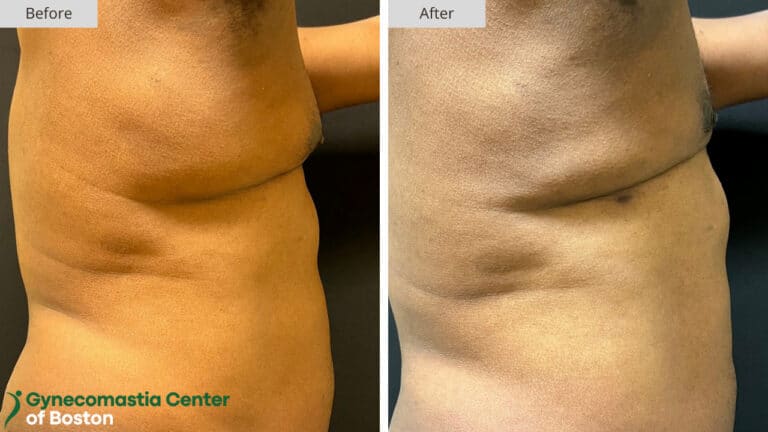
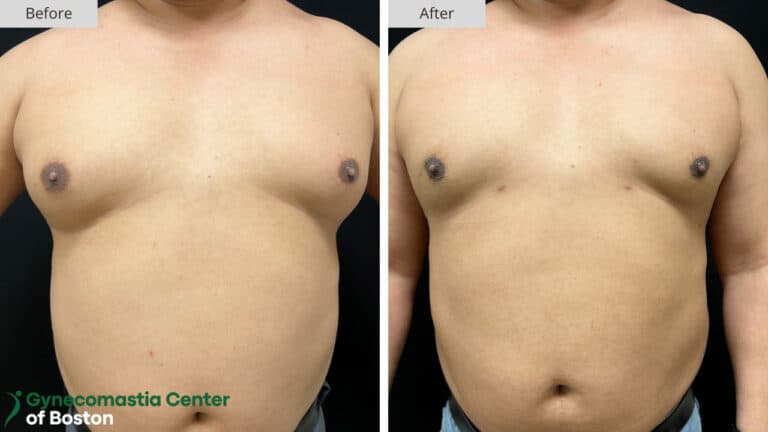
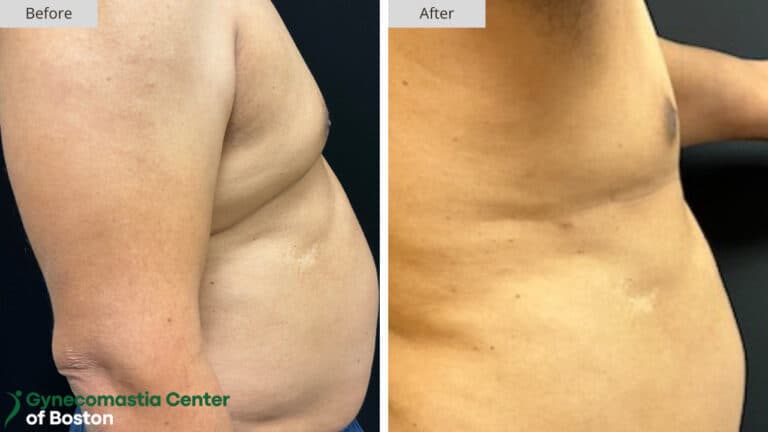
Before: A Chest That Didn’t Match the Rest of Him
This patient came to the Gynecomastia Center of Boston with a clear concern, the fullness in his chest had been there for years, and nothing he did seemed to make it go away. From the front, his chest appeared rounded and full. From the side, the projection of tissue beneath the nipple created a slope that resembled a breast profile, especially when relaxed or shirtless.
He was otherwise in good health. His weight was stable, and his routine was active. But the disproportionate appearance of his chest caused discomfort both physically and emotionally. Like many men dealing with gynecomastia, he had tried to “train it away” at the gym. But as we often explain during consultations, glandular tissue does not respond to exercise, and for this patient, that was a major part of the problem.
He was ready to take a more definitive step.
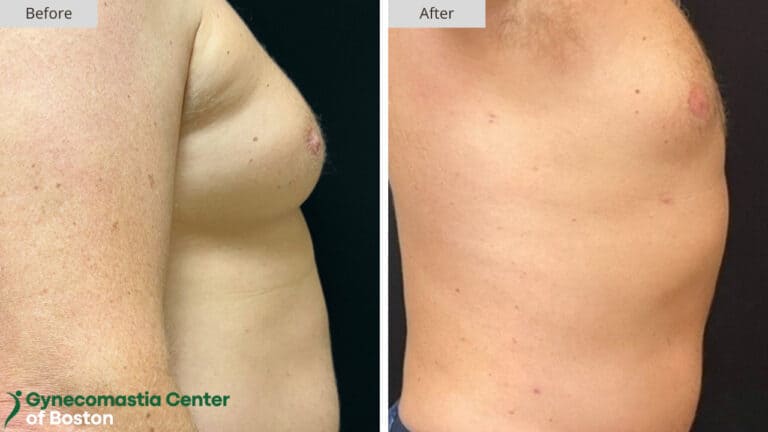
During: The Procedure That Made the Difference
After evaluating the density and distribution of tissue in the chest, we recommended liposuction-assisted gynecomastia surgery. This approach allows for a powerful combination:
- Liposuction to remove soft fat around the chest wall and upper abdomen
- Direct excision of glandular tissue through a small incision hidden at the border of the areola
- Chest contouring for symmetry and a smooth transition across the pectoral region
The procedure was performed under local anesthesia with sedation in our accredited surgical suite. There were no drains used. The incisions were small and well-placed for minimal visibility. The entire operation was completed in under two hours, and the patient went home the same day wearing a compression garment to support healing.
After: A Complete Resolution of Fullness
Recovery was smooth and uneventful. Within the first two weeks, much of the swelling had gone down, revealing an immediate difference in chest shape. By the one-month mark, the dramatic improvement in contour was clear, especially in profile. The outward projection was gone. The chest now followed a natural, masculine slope with no puffiness, bulging, or glandular prominence.
By six weeks, the patient had resumed normal activities, including upper-body exercise. He was no longer limited by clothing choices. Most importantly, he no longer felt like he had to hide or explain his chest.
His results show:
- Full removal of the tissue that caused his breast-like contour
- A smooth, firm chest without indentations or irregularities
- Balanced proportions with no sign of previous asymmetry

Final Reflection
For this patient, the transformation was more than physical. The chest fullness that once drew unwanted attention and discomfort had been completely resolved. His new contour looks natural, strong, and proportional without the signs of surgery.
This case is an excellent example of what happens when gynecomastia is addressed at its source. At the Gynecomastia Center of Boston, we tailor every procedure to the patient’s specific needs, and this kind of outcome is exactly why so many men choose to take the next step.